Logo design trends 2026
Lee Dean
Kill me now.
I usually sell against trendy designs. Why? Because by definition they don’t last. I prefer to make “Logos that Last”. It’s sort of a catch phrase.
Staying current
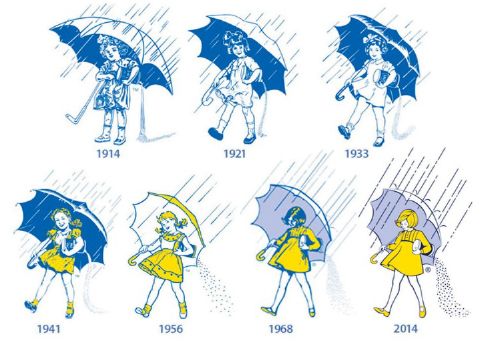
Now, having said that, I see no reason why a logo can’t evolve to stay up with the times. We’ll get to “trends” in a bit. In the past, I’ve used the Morton’s Salt logo as an example. It’s the image used for this blog. It shows the evolution of the mascot style logo from 1914 to 2014. 100 years of a logo that lasts, but it has been updated six times since it’s inception. With each iteration, not only does the style of dress and hair change, but the style of the drawing as well. It also gets simplified. The girl’s expression also changes from looking “at camera” if you will, to looking down. The proportions of the body are more properly drawn. The position of arms and legs are slightly altered. Unneeded detail is removed.
But the concept is the same throughout.
If you don’t have a container of this brand in your kitchen right now, chances are you have seen it and know it. Sure, you may have Himalayan Pink Salt in your cabinet at the moment, but do you remember the packaging off the top of your head? Mostly likely not, is my guess.
Is rebranding good?
Yes, in a word. The example above could be considered rebranding, though I see it as an evolving brand. But in general, a rebrand can positively affect the bottom line. From a presentation I did at a former employer, here is what I found during my research to convince upper management to rebrand:
A case study by Marketing Sherpa: — Aptean, a global software company —
“SUMMARY: To the outside observer, B2B companies can often look a bit like Dr. Frankenstein’s monster — made up of many parts via acquisition and merger. However, it is important for these enterprise companies to appear as a unified brand for the big picture marketing strategy.
Aptean wasn’t “formed organically,” according to Haraway. Rather, it “[was] formed by acquisition.”
— Will Haraway, Director of Global Marketing and Communications
RESULTS: The most important result of Aptean’s rebranding campaign is a $21 million sales pipeline that can be directly attributed to marketing efforts. Other metrics from the effort include:
- Website traffic increased year-over-year 36.62%
- Organic search traffic grew 52.58%
- A multi-touch drip marketing campaign generated 200 leads
- Media relations efforts generated 32 placements of bylined articles and interviews.”
https://www.marketingsherpa.com/article/case-study/rebranding-campaign
Let me point that out again:
$21 million in sales
As a result of a rebrand. Not bad.
But you may say, “hey, this article is supposed to be about logo trends!” Okay, okay, for the sake of SEO, let’s get on with it.
Logo trends for 2026
I look at logo portfolios on Fiverr, Behance, Upwork, and in Google searches while doing research for my client’s logos, and while preparing to promote my own business. Generally, my purpose is to avoid the appearance of plagiarism, as there is a finite set of solutions for any given business type/class/vertical etc. My thoughts are typically unique as I approach an assignment, but it doesn’t hurt to know for sure.
What’s out there?
As I look through these various sources which normally span a lot of time, I could not point you to what I would consider a true trend for this year. If you put a gun to my head, I would say “minimalism” is what appears to be popular. It comes up a lot on the big logo sites mentioned above, and in many of the descriptions I read from potential customers when I bid on jobs. Depending on how you define it, minimalism is how I would define most of the logos that have survived over time. This is taking “mascots” out of the equation, like the Morton Salt girl. I would point to brands like Apple, Nike, IBM, AT&T, Coca-Cola, Pepsi, GE, FedEx, McDonald’s, Chanel, Shell Oil, even relative newcomer Amazon to name just a few. What do they have in common? They are simple. They have all evolved over time, typically to be simpler than the original. For some of them, so much money has been spent in advertising and overall brand recognition, these companies can get away with using only the mark without the name, e.g. Apple, Nike, McDonald’s. And yet, these symbols are instantly recognizable to consumers.
Now, of course, we have all seen versions of these in color and 3D illusions (a 2D rendering made to look three-dimensional), lit up on signs, animated in video and so forth. But the core designs are simple. They can be used in black and white. I have some clients whose minimalism had me stop at black and white. There are no color versions of their logos. That’s okay, you can do some cool stuff with flat all black or all white logos.
There was a time when Illustrator and Freehand became capable of gradients. Then there were gradients everywhere, on everything including logos. It got out of hand.
There was a time when Photoshop became the dominant image manipulation software, and designers went a little crazy with 3D illusion effects. There were drop shadows, beveled surfaces, glows, and more—the whole kitchen sink—on a logo. It was taken too far, the bitmapped images looked great on screen but could only be resized to about 200% of the original before pixels started to show up. This was impractical, at least at the time.
Having said that, there is a place for gradients and glows, but the “bones” of the logo need to be sound. Reference the famous logos above.
Sadly, what has now emerged as the next baroque or overdone method is what I’ve seen done with Artificial Intelligence.
A client not-to-be named did a cross promotional ad I saw, and I couldn’t understand at what I was looking, at first. Then after a bit of examination, I realized there was, ensconced in all the imagery, some actual bulleted sentences. The letters were tiny and made with guess what? Made with drop shadows and bevels. There were badges and logos and extensions of badges to hold the type, no real headline, borders all over the place, illustrations of the two companies’ markets, stars and flames and people and parts of people. There were phrases floating about everywhere. Nothing dominated the ad, no target, no CTA. It was as if the AI prompt was “combine our businesses as if they had been vomited on a page”.
All that power, to create, but without a trained professional to guide it, it was pure excrement.
Even though the technology is cutting-edge, it reminds me of back in the day when people would ask me, “If I got a Mac with the software you use, can I be an artist?”. My reply was always something to the effect that a typewriter doesn’t make you an author. What’s a “typewriter” you may ask. Well, never mind, ask your parents. The point is, technology is a tool, not the easy path to a goal. And the same stupid mistakes can be made with the latest tool that were made in the past — and have been.
What makes for a good minimalist logo?
Obviously, no ostentation. For some, only a logotype/wordmark will do. For others, they want the symbol to be dominant. Either can be minimalist. Some examples in my own work would be:
• Vertical Capital Income Fund
So quite a few, by design.
In these you will see a mix of serif and sans-serif typefaces. Some people think only sans-serif typefaces should be used on websites, but the truth is, monitors and the software that drives them have come a long way since the ’90s. That means that the tiny curves and shapes that used to be cut off or appeared as chunks, or more likely blurred, now show up just fine. On this very site, I use a serif face for headlines. No worries at all. Ironically, phones generally have higher resolution now than desktop computers.
Some concluding thoughts
- I think minimalism rules the day for 2026, and that’s a good thing.
- Your logo should fit your brand. Some brands best logo may be ornate and complicated because that represents the product/service, but mainly because it appeals to the target audience.
- Define your brand beforehand—I assume most people have something in mind before they contact a designer. If you don’t, you should.
- Definitely look at the designer’s work. I’ve had people call me from a Google search, and they’ve never seen the work on my website. There are lots of reason to look at the work first before you call.
- Ask about experience and experience in your industry. I should qualify this statement. Some designer’s may not have any experience in your industry, but design skills transfer. Just make sure they know enough. I have a Creative Brief for just this kind of thing.
- Look for a portfolio of Logos that Last, not just the latest shiny new object (trendy logo styles).
Give Logo Hammer a call!
214-697-9849