Brand on a budget?
Lee Dean
Do you need a brand identity design?
If you bought a logo, you are already on your way.
What is a brand identity?
We’re glad you asked. We are not talking about hot iron brands on cattle here, but rather the second definition: 2. The promotion of a particular product or company by means of advertising and distinctive design. “The process of branding should be considered in global terms” distinctive wording or design used to identify a particular brand. “The first thing you’ll notice is the cool blue branding”
Thanks to OxfordLanguages for their definition.
Notice it says, “wording or design”. At Logo Hammer, we believe this, despite our focus on logos. Our background is in comprehensive, 360-degree marketing and branding. The definition is probably no surprise to you if you are reading this article, but it’s good to have a common base to start with.
What is a brand worth, besides just goodwill? What about monetary worth?
By amazing coincidence, we have an article on that, it’s about brand equity. Here is a snippet from that article:
- Apple: brand value of USD 574.5 billion, up 11% from 2024
- Microsoft: brand value of USD 461.1 billion, up 35%
- Google: brand value of USD 413.0 billion, up 24%
- Amazon: brand value of USD 356.4 billion, up 15%
- Walmart: brand value of USD 137.2 billion, up 42%
Hat tip to Brand Finance.
Notice this is NOT the profits of these companies, or the net worth, or other GAAP standard measures. This is Brand Equity.
These brands are worth so much for many reasons. One of the reasons these brands are worth billions is because they’ve spent millions to get there. If you have a million or two, we’d love to help you out. But so far, that hasn’t been part of our experience. Unless you count Blockbuster, but that was a long time ago and before they had millions to spend.
Enough of the theory, what can the small business owner expect to pay?
Not millions, not even thousands. We offer more down-to-earth options.
We are a small business too. So, we understand the fiscal constraints small businesses have. Chances are, we can help you out even on a tiny budget.
Though you may not have the budget to create a comprehensive brand book, our intent is to build it as we go, informally. As a responsible brand design company, this is what we do.
It could be as simple as a text file, with some of the items listed below. We don’t recommend this, but it’s helpful for essential elements like color modes, and typography.
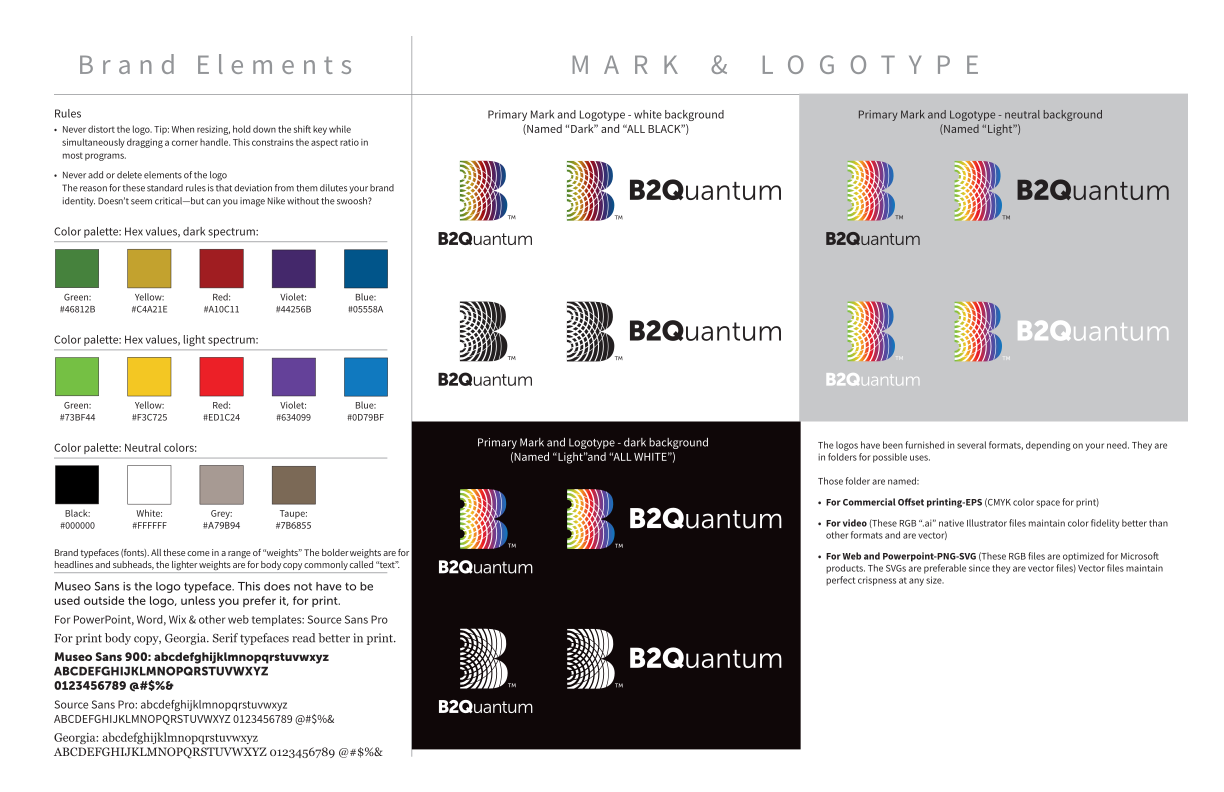
Many of our clients request a simple one-page guide. This will provide the basics, in fact we call it
the Basic.
We will include a minimum of:
- Brand rules for the logo
- Color palette with breakdowns for print, and digital
- Typography
- Logo usage on a variety of backgrounds
- A description of how the formats are organized, and how they are to be used
You may be wondering, how much is a one-page brand guide? We’re glad you asked. See our Prices page for details.
We offer four tiers of brand guides, depending on your budget. Here is the top part of the table on the Prices page:
| Basic | Standard | Deluxe | Premium |
|---|---|---|---|
| $300 | $450 | $650 | $1,350 |
| 1 page | 2 pages | 10 pages | 21 pages |
It may not seem cheap to you, but believe me, there is bang for the buck here. An ad agency or big design shop would charge triple or quadruple the amount we do. See our blog on that.
Much of the increase as you go up the tiers is due to sample creation or applications. In other words, we can provide a visual that simulates not only the logo, but how the logo can and should be applied to several marketing “deliverables” or “applications”.
Applications/Deliverables defined:
These are visual examples of how the logo is applied to a specific deliverable, such as a business card, one sheet/flyer/sales sheet/insert, signs, collateral, packaging, or ad specialties, etc.
The Standard
The Standard is a just bit beyond the Basic book. This is often a necessary expansion to add Do’s and Don’ts or other rules and examples.
The Deluxe
Then there are other elements, such as in the Deluxe tier where we add elements like how to treat photography, format tips, motifs, etc. It’s all broken out on the Prices page.
the Premium
In the Premium tier, a good example is the brand book for Vertical Capital Income Fund is about 20 pages. The following book is for Insignia macro fund and is a part of the same pdf in the link above.
For the standard brand books and up, we typically recommend graphic “devices” to be ready to use, as motifs in a brand. Here are some visual examples; see the link, along with the explanations below.
In the two examples on this link, we used parts of the logos as a motif throughout the brands. Note that it’s not a “bastardization” of the logo (yes that’s a legitimate term), but instead taking a small element from the logo, and using it to expand, communicate and reinforce the overall brand. It absolutely DOES NOT need to be a piece of the logo. The motif can be anything that contributes to the goal of—again—expanding, communicating and reinforcing the brand.
Below are a couple of well-known examples of a motif:
- Louis Vuitton Monogram: Beyond the “LV,” the repetitive pattern of stylized flowers and quatrefoils is an instantly recognizable luxury symbol.
- Coca-Cola Contour Bottle: The unique silhouette of the glass bottle is a trademarked physical shape that signals the brand even in silhouette.
Now, back to our stuff: The VERTICAL logo has a stylized “I” to represent the side of a building or an arrow pointing up indicating profit. This was used throughout the brand—see pages 7, the table of contents button on all pages, and page 15. Along with this element, vertical pinstripes in various brand colors are used throughout all the deliverables. Those blocks are used functionally to provide a space for headlines, or as simply a structural element to guide the alignment of items on a page.
Following that is the Insignia Macro Fund guide, which uses rounded rectangles and natural elements related to the leaf in the logo representing growth. This concept was applied to both flat graphics and photography. Lots of flexibility, and no mandate for them to be present.
We like to create one or two motif elements for a brand. A brochure or another item like letterhead or website, is an opportunity to begin just that. Again, it doesn’t have to come from the logo, but it could be abstractly related to it.
Then of course as budget allows, we will address color palette, typography, voice, photography and illustration, how to use the logo, and samples as the brand is built out.
Some clients require only a single page to get started. Others require more extensive information as seen in the samples, and everything in-between.
Almost anyone can afford the text file (it’s free unless you get crazy on us), but many can afford the Basic brand guide. The Standard does not cost much more, and it will be helpful to others. In fact, let’s talk about that a bit:
Brand Communication
What is the practical value of a brand guide?
We often say, if we are hit by a bus tomorrow, you will have a document that can be passed on as needed. In reality, some clients already have sources other than Logo Hammer for things — perish the thought — but it’s true. For example, you may have engaged a website provider before you contact us. Even though we could do the site, we aren’t the jealous type. Good branding is about expanding the brand so that all your vendors are singing from the same sheet music. In addition to the various logo formats, we provide brand information that the web provider can use; they will want to know about color, typography, photography, etc. A brand guide, even a one-pager provides most of that elemental information.
Once a brand is established, and a brand style guide is in published form (usually a pdf), it can go to sign companies, apparel companies, ad specialty firms, printers and so on. Everyone then will have the correct color information, whether it’s digital or physical. They will know what typefaces (a font is a subset of a typeface) to use, and what NOT to do with the logo.
Our recommendation?
Do it! It will be worth every penny, rather than making lots of phone calls, sending multiple emails, or texts trying to make everyone do everything consistently. Imagine the time saved. That is worth paying for!
There are many ways to contact us:
This is the form: https://www.logohammer.com/contact
This is the email: lee@logohammer.com
This is the telephone: 1 (214) 697-9849