Line Extension Branding
Lee Dean
What’s the difference between line extension and brand extension?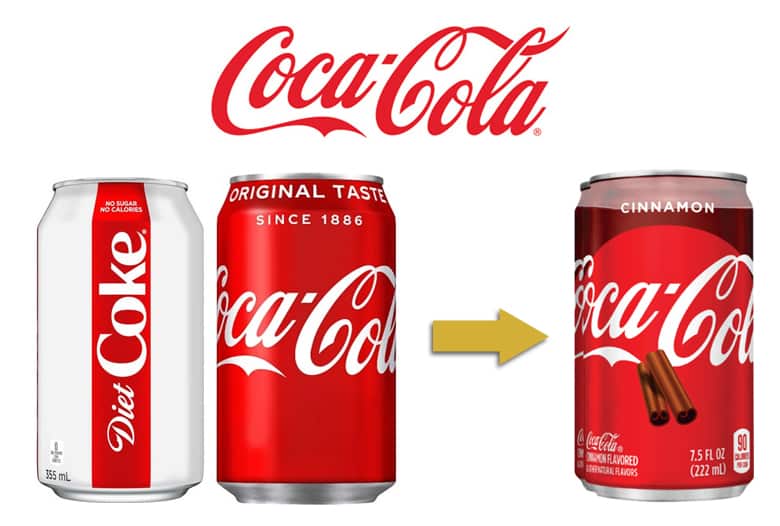
Let’s take a broader view on the consumer side, as the examples are easier to understand.
Line extension is changing the original product slightly to fill consumer demand, in the hopes of preventing them from going to the competition for the same thing.
The easiest example to cite is Coca-Cola, because it is so well known, and so long established. The original product, Coca-Cola, has been line extended greatly. Diet Coke, Coke Zero, Cherry Coke, Vanilla Coke, and other flavor variations are offered, but they are all still sodas.
The Coca-Cola company also does brand extension. Maryland Club coffee, Minute Maid juices, Dasani, Smartwater, Vitaminwater, Powerade, Honest Tea, Gold Peak Tea, and Georgia Coffee were at one time all brand extensions. Some were sold years ago. The point is, even though these are all beverages, they are NOT sodas.
See the difference for Coca-Cola? Line extension: all sodas Brand extension: all beverages
The aim of both line extension and brand extension is essentially the same—capture more market share by leveraging the primary brand.
Notice if you buy a line-extended item, you know exactly who produces the product. Typically, the identity is in the name. However, back in the day, when Maryland Club was owned by Coca-Cola, it was named and branded in a completely different way. But if you looked on the blue can at the bottom, you would see a tiny black Coca-Cola logo. What’s the point in that? It tells the consumer who feels favorable to Coca-Cola, that this product should have the same quality and attributes of the primary brand.
If your company has good brand equity (see my related article) then, line and/or brand extension makes sense, and should produce an edge over unknown brands.
Here is an example from our portfolio:
TechBridge Digital LLC TechBridge is a company for multifaceted digital automation, websites and web hosting.
They are still doing that but are also doing line extension and have since formed Detailers 360º, which targets car detailing companies who need an all-in-one software solution for their business. This is a line extension which is less obvious than the Coke example, because the parent company name in not in evidence. Detailers 360º targets a specific group of potential customers, in this case automobile detailers. Detailers 360º does multifaceted digital automation, websites and web hosting (same as TechBridge Digital). Why? Why did they do this? The conventional wisdom is obviously to increase revenue, brand relevance and market share. In this case the first and third reasons line up, but not so much the second. Since the name is different, there is little correlation at least publicly to brand relevance. I think Wikipedia is closer with the notion that it blocks competitors. Even more compelling, is the idea that most people are more comfortable with a company that specializes in their line of business. It’s a “birds of a feather flock together” mentality.
And we are still not done. TechBridge has also brand extended with a product called PrivaVault. PrivaVault keeps your sensitive documents secure with military-grade encryption. It uses a technology called “zero-knowledge architecture”. That’s somewhat of a misnomer. Zero-knowledge architecture simply means that only YOU know what’s stored in your vault. Not even the company knows. So that’s very secure.
To the public’s eye, this has nothing to do with TechBridge. But if an investor or merely a curious user digs even casually, they will find the connection. On the Apple App Store, the authors are named, one of them being John Glennan, who also happens to be the founder of TechBridge and Detailers 360º. Ta-da, brand extension has now given credibility to PrivaVault. Even though it’s all in the realm of technology, the app and the web building sites are different animals altogether.
Positioning
We would be remiss if we left out the idea of positioning. There is a book that came out in 1981 called “Positioning: The Battle for Your Mind, by Al Ries and Jack Trout”. Anyone who sells anything should read this book. This had a massive effect on how marketing and advertising peeps considered all aspects of selling. This of course, affects line and brand extension. The core concept is not about what one does with the product or service, but rather, where does that product or service live in the mind of the buyer? Ideally, you want to own that space in their head. To do that, you have to cut through the clutter that blitzes every prospect every day of their lives. This applies equally to Business to Business and Business to Consumer messaging.
Here is the synopsis from the Amazon link above:
“The first book to deal with the problems of communicating to a skeptical, media-blitzed public, Positioning describes a revolutionary approach to creating a “position” in a prospective customer’s mind-one that reflects a company’s own strengths and weaknesses as well as those of its competitors. Writing in their trademark witty, fast-paced style, advertising gurus Ries and Trout explain how to:
- Make and position an industry leader so that its name and message wheedles its way into the collective subconscious of your market-and stays there
- Position a follower so that it can occupy a niche not claimed by the leader
- Avoid letting a second product ride on the coattails of an established one.
- Positioning also shows you how to:
- Use leading ad agency techniques to capture the biggest market share and become a household name
- Build your strategy around your competition’s weaknesses
- Reposition a strong competitor and create a weak spot
- Use your present position to its best advantage
- Choose the best name for your product
- Determine when-and why-less is more
- Analyze recent trends that affect your positioning. Ries and Trout provide many valuable case histories and penetrating analyses of some of the most phenomenal successes and failures in advertising history. Revised to reflect significant developments in the five years since its original publication, Positioning is required reading for anyone in business today.”
How does this affect line and brand positioning? Pretty much in every way. To use Coca-Cola as an example, if it did not already own a huge position in your brain (even if you’re a Pepsi fan) would you have tried the line extended Cherry Coke or Coke Zero if you had never heard of Coca-Cola? Most likely not. Yes, the positioning concept is that simple. Getting there is the challenge. As the author’s say, being first is best. And you have to spend some money to get there. We recommend starting with a great logo, but we digress.
It’s possible to learn from failures as easily as successes. Everyone know how great Xerox computers are, right? No? Here’s why:
In the book, the authors tell the story of a Xerox line extension debacle. No disrespect to Xerox, as they DO own the position of THE copier in our minds. So, have you ever seen a Xerox computer? Of course not. The reason is that they were so successful and so dominant in owning the copier position, no one trusted them to make a great computer. Back in the day, computers were bought from IBM, Wang, (insert your own joke here) and others. Xerox had been so successful in owning the copier position, they could not dislodge it from prospect’s minds. However, in 1970 Xerox developed a software system for their computers called Xerox PARC. PARC stands for (Palo Alto Research Center). It used a mouse, a graphical user interface, laser printing, ethernet (to connect computers). Any of that sound familiar? Obviously, it does. But if the line extension was such a failure, how did these ubiquitous things come about? Well by 1979 this software was languishing in the PARC lab when a visitor named Steve Jobs saw it. He immediately saw the value and eventually made a deal with Xerox to emulate and improve the technology. You have heard of Apple Computer. You could say Xerox was proven right, but they are not the most valuable company in the world now. Apple trades off with Microsoft and Nvidia for those bragging rights, but not Xerox.
Those are mammoth companies, but the same positioning logic applies everywhere, to every company. Get there first if you can, or poke holes in the brand of whoever did get there first.
How do you poke holes in the competition?
This is a classic, from freethink.com
“In the 1930s, the copywriting legend Claude Hopkins helped boost the sales of the American beer brand Schlitz. He did so through a rather straightforward ad campaign that focused on the purity of Schlitz beer, touting lines like: “We wash our bottles with live steam!” The campaign was all true. But what most consumers probably didn’t realize was that all beer producers steam-cleaned their bottles. Schlitz was simply boasting about a product feature that was neither original nor uncommon, a strategy that later became known in the advertising world as the preemptive claim.”
I love that story. So, line/brand extend with courage.
By the way, this blog is an editorial context, which allows the use of copyrighted material for criticism, comment, news reporting, teaching, scholarship, and research.1
Editor’s note: I applaud and respect the protections of intellectual property laws, and any company represented above who makes a request for deletion will have that request honored.
Give Logo Hammer a call!
214-697-9849
The image was found on the Brandmarketingblog.com website2.
1 https://www.copyright.gov/fair-use/
2 https://brandmarketingblog.com/articles/good-branding/line-extension-examples/